
The holiday cottage
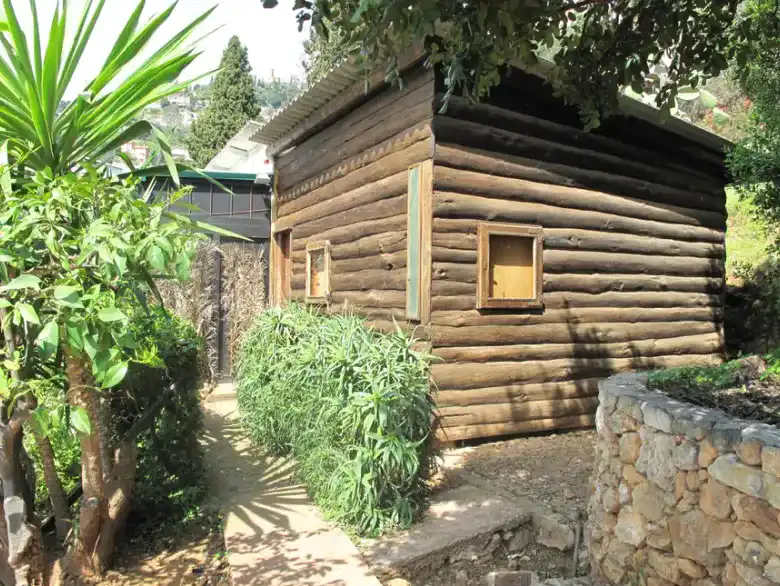
The Cap Martin site, with its cabanon, is a UNESCO World Heritage Site. Managed by the Cap Moderne association, it offers tours, bearing witness to Le Corbusier's architectural ideas on standardisation and modernity.
Patrimony
The Site Corbuséen du Cap Martin is a group of buildings designed by Le Corbusier that can only be reached by the coastal path known as the customs officers' path, at Roquebrune-Cap-Martin in the Alpes-Maritimes in France. Le Corbusier's cabanon bears witness to his thoughts on standardised production. Along with 16 other architectural works by Le Corbusier, the site was inscribed on UNESCO's World Heritage List World Heritage List in 2016.
History
The Corbusian site at Roquebrune-Cap Martin includes :
- the "Étoile de Mer" dance hall, built by the cabaret owner Rebutato in 1948-1949,
- the adjoining garden shed added by Le Corbusier in 1952,
- the camping units, a juxtaposition of five identical cells built in 1954-1957.
Having gradually become the owner of the entire site, the Conservatoire du Littoral first entrusted the management of the site to the commune of Roquebrune-Cap-Martin. to the municipality of Roquebrune-Cap-Martin. During its years of management, the municipality has helped to safeguard the site by by supporting a number of initiatives, including major restoration work on villa E-1027. Visits to the cabanon and Étoile de Mer are regularly organised by the tourist office, subject to prior booking. Since September 2014, the management of the site and the organisation of tours have been entrusted by the Conservatoire, in agreement with the commune, to the Cap de la Mer association. the Cap Moderne association. Cap Moderne receives financial support from the Eileen Gray Le Corbeil Eileen Gray Le Corbusier à Cap Martin endowment fund.
Monument
The Corbusian site was listed on 25 March 1994 and the cottage was classified as a historic monument on 3 September 1996. The site was awarded the "Label Patrimoine du XXe" siècle (20th Century Heritage Label) by decree on 1 March 2001. A number of sites built by Le Corbusier (including the cabanon) have already been rejected as UNESCO World Heritage sites. UNESCO World Heritage List was rejected in 2009 and again in 2011 because the list was too long and the Chandigarh site in India was not included. A new application, taking into account the various comments made, was submitted at the end of January 2015 and will be proposed at the 40th session of the World Heritage Committee. at the 40th session of the World Heritage Committee, held in Istanbul (Turkey) from 10 to 17 July 2016. The site was finally listed on 17 July 2016.